How to follow VALORANT Champions Shanghai group stage like a pro analyst
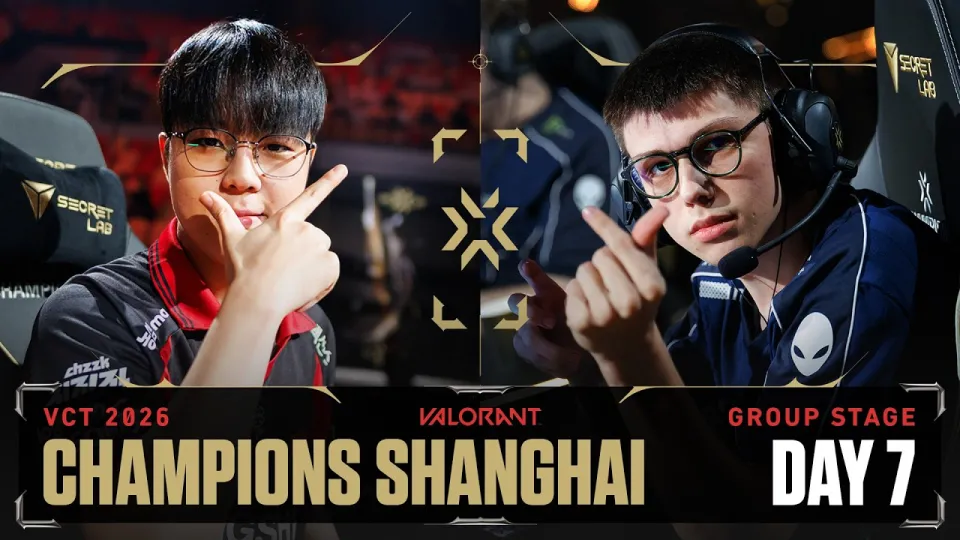
Video: VALORANT Champions Shanghai — Group Stage — Day 7
Want articles like this for your own video to promote it on YouTube and Google? Order them through the Telegram bot @sat_sit_bot. It writes articles around your video, embeds the video and publishes them on popular niche websites (no ads). Free trial — 50 articles.
· based on the channel VALORANT Champions Tour
Key takeaways
- VALORANT Champions Shanghai runs September 24 to October 18 and crowns the 2026 World Champion.
- Sixteen teams from Americas, CN, EMEA and Pacific compete in the group stage before the playoff bracket.
- Day 7 of the group stage is the VOD covered by the VALORANT Champions Tour channel.
- Two different Masters champions in 2026 set up an unusually open field in Shanghai.
- Official updates, brackets and schedules come from the VALORANT Esports channels linked in the broadcast.
VALORANT Champions Shanghai is the final VCT event of the 2026 season, where sixteen teams from Americas, CN, EMEA and Pacific fight for the World Champion title between September 24 and October 18. To follow it properly, treat the group stage as a qualification puzzle rather than a highlight reel: track who needs which map wins, watch how teams handle the patch, and use the official VALORANT Esports updates on X for brackets, schedules and results. Day 7 of the group stage, published by the VALORANT Champions Tour channel, is a good entry point because it shows the middle of the Swiss-style grind where seeding and elimination pressure collide.
What the VALORANT Champions Shanghai group stage actually decides
The group stage exists to cut sixteen teams down to a playoff bracket, and every series reshapes the seeding on both sides of the table. Champions uses a format where early wins push a team toward a direct playoff seed while early losses drop it into elimination series, so a single bad map can change a team's entire path. That is why Day 7 matters: by then, some rosters are playing for a top seed and a favorable quarterfinal draw, while others are already in must-win territory.
A practical way to read the standings:
- Count series wins first, not map wins — the bracket reacts to series results.
- Check map differential, because tiebreakers often come down to round or map margin.
- Identify which teams are one loss from elimination and which are one win from locking a seed.
- Note the region split (Americas, CN, EMEA, Pacific), since regional strength arguments dominate the discussion around every international event.
The 2026 context that makes this Champions unusual
The 2026 season produced two different Masters champions, which is exactly the kind of signal that makes a world championship unpredictable. When no single roster dominates the international calendar, group stage results become the best available evidence of who has actually solved the current meta. The broadcast description frames Shanghai as the moment when familiar names, new contenders and a fearless generation of challengers all meet for the biggest trophy of the year — and the results so far support that framing.
For viewers, this means a few concrete things to watch:
- Draft priority on the newest or most-contested maps, where preparation gaps show up fastest.
- Utility usage in post-plant and retake situations, the area where disciplined teams separate from improvisers.
- Pistol round conversion, which often decides close series between evenly matched rosters.
- Adaptation after a lost map, because Champions group stage series reward teams that reset quickly.
How to watch Day 7 of the group stage with full context
Day 7 is a full broadcast day, so the efficient approach is to watch the series that matter for seeding and skim the rest. Start with the standings snapshot from the official channels, then pick the matches involving teams on the elimination edge. The Day 7 VOD from the VALORANT Champions Tour channel runs long, which is normal for a multi-series broadcast day, and it includes the desk segments that explain bracket implications between maps.
A workable viewing routine:
- Pull the current group standings from VALORANT Esports on X before pressing play.
- Watch the opening map of each series to read the draft and pistol rounds.
- Skip to the deciding map of any series that goes the distance.
- Note which teams won on their opponent's map pick — that is the strongest signal of a deep playoff run.
Why tech pauses keep interrupting the broadcast
Tech pauses are the most discussed annoyance around the Shanghai group stage, and they are worth understanding rather than just complaining about. Long broadcast days with multiple series, player equipment checks and server-side issues produce pauses that can stretch for minutes. In a VOD, those pauses are dead air; in a live setting, they are the production team buying time while the match is restored.
The practical takeaway for viewers is simple: pauses are not a signal about match quality, and they rarely change the outcome. If you are watching a replay, skip forward past the freeze; if you are watching live, use the downtime to check the bracket and the other concurrent series. The same applies to the occasional odd in-game moment that looks like a bug — a clone or decoy behaving unexpectedly is usually a visual quirk of the spectator client, not a rules violation.
Reading the regional debate without the noise
Every international VALORANT event produces a regional strength argument, and Shanghai is no exception. The loudest version of that debate claims that stronger teams from some regions were left out of the sixteen-team field, or that one region's representatives are underperforming relative to their domestic form. Both claims are hard to prove from a single group stage.
A more useful framework:
- Compare results against common opponents rather than across regions in the abstract.
- Weight map picks and side choices, since some teams win on comfort picks that do not translate internationally.
- Separate execution errors (lost 5v2s, eco losses) from structural problems (no plan when set plays break down).
- Remember that a single group stage series is a small sample, and playoff series with more preparation time tell a different story.
The criticism that some teams look lost once their prepared strategies fail is a real observation about adaptation, and it is the single most predictive trait for how far a roster can go in a double-elimination bracket.
Useful links for following the tournament
All official channels for schedules, results and broadcast times are listed in the event description, and they are the fastest way to confirm a result before the highlight channels catch up.
- VALORANT Esports on X — announcements, results and bracket updates.
- VALORANT Esports on Facebook — event posts and photos.
- VALORANT Esports on Instagram — behind-the-scenes content.
- VALORANT Esports on TikTok — short clips and highlights.
- VALORANT on Twitch — live broadcast of match days.
How the group stage sets up the playoff bracket
The group stage is the part of Champions that decides matchups, not the champion, and that distinction shapes how you should judge it. A team that squeaks through with a low seed can still win the event if its map pool suits the bracket; a team that tops its group can still lose its first playoff series to a bad draw. What the group stage reliably reveals is which rosters can adapt within a series and which depend on a narrow set of prepared strategies.
Watch for three signals as the bracket forms: which teams win on their opponent's map pick, which teams recover after losing the opening map, and which teams keep their utility discipline under elimination pressure. Those three traits tend to hold up in playoff series, while raw aim duels become less decisive as opponents get more preparation time.
Final thoughts
The Shanghai group stage is best read as a qualification and seeding exercise: sixteen teams, four regions, and a bracket that rewards adaptation over raw firepower. Day 7 of the broadcast captures the middle of that grind, complete with the tech pauses and regional arguments that come with every international VALORANT event. Use the standings, map differential and draft choices as your primary evidence, and treat single-series upsets as data points rather than verdicts. For schedules, brackets and confirmed results, follow VALORANT Esports on X — it remains the fastest official source. The full Day 7 broadcast is available on the VALORANT Champions Tour channel, which produced this tournament coverage.
Questions & answers
How does the VALORANT Champions Shanghai group stage format work?
Sixteen teams from Americas, CN, EMEA and Pacific play a series-based group stage where early wins push teams toward direct playoff seeds and early losses move them into elimination series. Series results, not map wins, drive the standings, with map and round differential used as tiebreakers.
Why are there so many tech pauses during the Shanghai broadcast?
Long broadcast days with multiple series, equipment checks and occasional server-side issues cause pauses that can last several minutes. They are a production issue rather than a signal about match quality, and they rarely affect the final result.
Where can I find official schedules and results for VALORANT Champions?
The official VALORANT Esports channels listed in the event description, including [VALORANT Esports on X](https://x.com/valorantesports), publish schedules, brackets and confirmed results. The live broadcast runs on [VALORANT on Twitch](https://www.twitch.tv/valorant).
Is it true that stronger teams from some regions missed Champions?
That argument appears at every international event, but it is hard to verify from a single group stage. A better approach is comparing results against common opponents and weighing map picks and side choices, since domestic form does not always translate to international play.
Source: VALORANT Champions Shanghai — Group Stage — Day 7 · Markdown version